For a long time, designing for additive manufacturing was treated as a constraint exercise. Engineers learned what not to do. Avoid overhangs. Reduce supports. Respect printer limits. Design lighter, but not too light.
Today, that mindset is becoming obsolete.
AI is changing how products are designed for additive manufacturing at a fundamental level. Instead of designers manually interpreting rules and limitations, intelligent systems are now exploring geometry, material behaviour, and manufacturing constraints simultaneously. The result is not just better parts. It is a completely different design process.
From rules-based DfAM to outcome-driven design
Traditional Design for Additive Manufacturing relied heavily on human intuition and experience. Designers worked within known constraints, iterating geometry step by step and validating through physical prototypes. This worked, but it was slow and inherently conservative.
AI-driven design flips that approach.
Rather than asking a designer to define the shape, AI tools ask for outcomes. Load cases. Performance targets. Weight limits. Manufacturing constraints. Sustainability goals. The system then explores thousands, sometimes millions, of possible solutions in parallel.
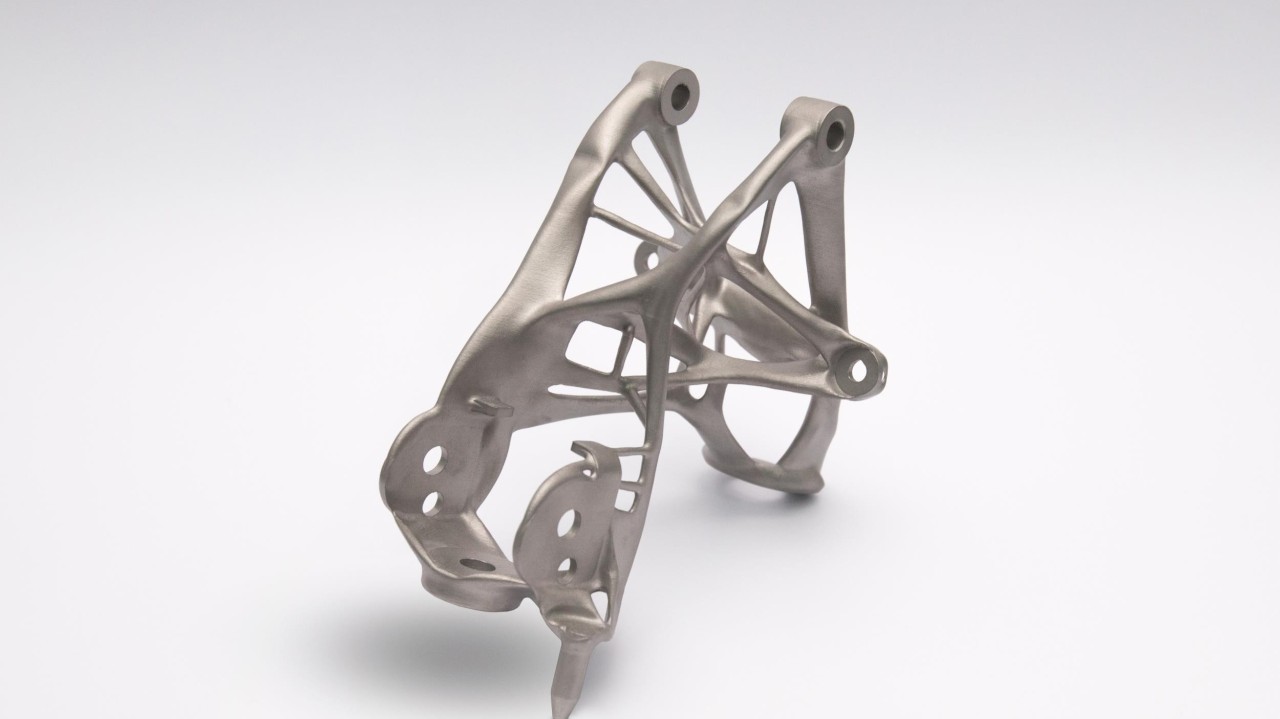
Platforms from companies such as Autodesk and nTop are already enabling this shift through generative design and computational workflows that would be impossible to execute manually. What emerges often looks unfamiliar at first glance, but it is precisely this unfamiliarity that signals progress.
These geometries are not designed to look right. They are designed to perform.
Geometry no longer needs to be simple
One of additive manufacturing’s biggest promises has always been geometric freedom. In practice, however, designers still simplified shapes because complexity increased design time and risk.
AI removes that friction.
Lattice structures, graded materials, organic load paths, and variable wall thicknesses can now be generated, analysed, and refined automatically. AI understands how a structure behaves across its entire volume, not just at discrete points. This allows designers to place material exactly where it is needed and nowhere else.
In sectors like medical devices and lightweight consumer products, this has profound implications. Components can be tuned for strength, flexibility, and comfort simultaneously, while remaining printable and repeatable.
Designing with manufacturing in the loop
Perhaps the most important shift is that AI does not treat manufacturing as an afterthought.
Modern AI-driven DfAM workflows integrate printer behaviour, material data, and post-processing requirements directly into the design phase. Support strategies, build orientation, thermal distortion, and surface finish are no longer checked at the end. They are optimised from the start.
This closes the gap between digital design and physical reality, significantly reducing the number of iterations required to reach a production-ready part. At ITERATE ®, this philosophy mirrors how feasibility and risk are addressed early, long before costly tooling or scale-up decisions are made.
Why this matters beyond engineering teams
The impact of AI-driven DfAM is not limited to engineers. It reshapes product strategy.
Faster design cycles mean earlier validation. Lighter and stronger parts unlock new form factors. Smarter material use supports sustainability goals without compromise. Most importantly, teams can make confident decisions earlier in the development journey.
For startups, this can be the difference between proving viability and burning budget. For established businesses, it enables innovation without destabilising existing manufacturing pipelines.
The designer’s role is evolving, not disappearing
AI does not replace designers. It changes what they focus on.
Human creativity, judgement, and user understanding remain critical. What AI removes is the manual burden of geometry optimisation and repetitive iteration. Designers are freed to think systemically, to ask better questions, and to explore opportunities that were previously impractical.
In many ways, AI brings additive manufacturing closer to its original promise. Not just new ways of making old designs, but new ways of thinking about what a product can be.
Looking ahead
As AI tools continue to mature, the distinction between design, simulation, and manufacturing will blur even further. Designing for additive manufacturing will become less about knowing the rules and more about defining the right intent.
The businesses that benefit most will be those that embrace this shift early, integrating AI-led design thinking into their product development strategy rather than treating it as a downstream optimisation.
If you are exploring additive manufacturing and wondering how AI-driven design could de-risk your next product or unlock new possibilities, it starts with asking better questions at the design stage.
If you’re looking to design and manufacture a new product with confidence, ITERATE ® can help you navigate that journey. Speak with our team and explore how AI-informed design and additive manufacturing can accelerate your path to market:

Gethin Roberts
ITERATE Business Development Executive
Stay in the Know
Do you want to stay updated on our latest projects, client insights, future tech trends, and social media highlights? Join ITERATE’s monthly mailing list!