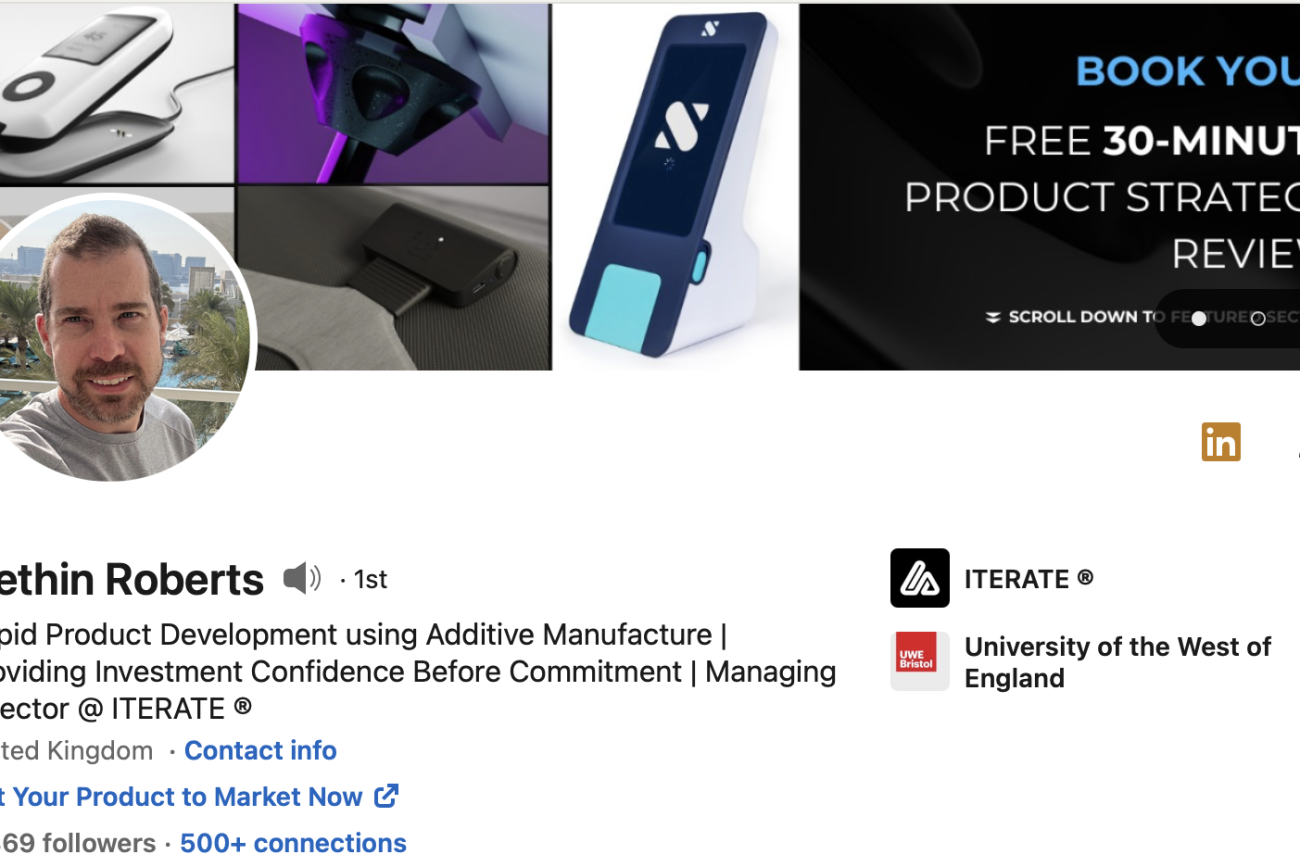
He is on LinkedIn most days, sharing ideas, commenting on other people’s posts, talking about product development and joining conversations across industry.
Partly, that is because he enjoys it. But there is another reason.
For a business like ITERATE, visibility helps people become familiar with who we are, how we think and what we stand for. Over time, that familiarity can help create trust.
And in product development, trust matters enormously.
Product development is a high-trust relationship
Buying product development consultancy is very different to buying a conventional product or service.
When a client appoints ITERATE, they are often investing significant time and money into something that does not yet exist. There may be technical risks, manufacturing challenges, regulatory considerations and commercial uncertainty still to resolve.
More importantly, the journey can last months or even years.
That means clients are not simply choosing a supplier. They are choosing people they will need to work closely with through uncertainty.
Trust matters most when things get difficult
And uncertainty is inevitable.
Prototypes fail. Assumptions are challenged. Manufacturing routes change. Costs increase. Testing uncovers problems. Features that seemed essential at the beginning of a project may later need to be reconsidered.
The strength of the relationship becomes particularly important at those moments.
A client needs to trust that problems will be raised early rather than hidden. They need confidence that recommendations are being made because they are right for the project, not simply because they create more work. And sometimes they need to hear things they would rather not hear.
That is why communication in our industry is about far more than providing project updates.
Good communication reduces uncertainty. It helps difficult conversations happen constructively and gives clients confidence that they understand where the project stands, what the risks are and why certain decisions are being made.
So where does LinkedIn fit in?
LinkedIn can start that process long before somebody becomes a client.
Someone might see Gethin discussing a project, read his thoughts on product development or watch one of our videos. They may follow ITERATE for months without ever contacting us.
But gradually, we become familiar.
Then, when that person eventually needs support, they are not approaching a completely unknown consultancy. They already have some understanding of the people behind the company.
That familiarity does not create trust on its own, but it can make the first conversation easier.
Visibility opens the door. Behaviour builds the trust.
Once a relationship begins, social media becomes much less important.
Trust is reinforced through behaviour.
Do we listen properly? Are we responding when we say we will? Who is ensuring we raise problems early? Are we prepared to challenge an idea? Do we communicate clearly when something changes?
Those repeated questions being asked, and accountability being taken, are what ultimately builds confidence over time.
For a high-value consultancy like ours, trust is not a nice extra. It is fundamental.
Because when somebody asks us to help develop a new product, they are not simply buying design capability.
They are placing confidence in the people who will help them navigate everything that happens between the original idea and the finished product.
And often, that relationship starts with something as simple as communication.

Gethin Roberts
ITERATE Business Development Executive
Stay in the Know
Do you want to stay updated on our latest projects, client insights, future tech trends, and social media highlights? Join ITERATE’s monthly mailing list!