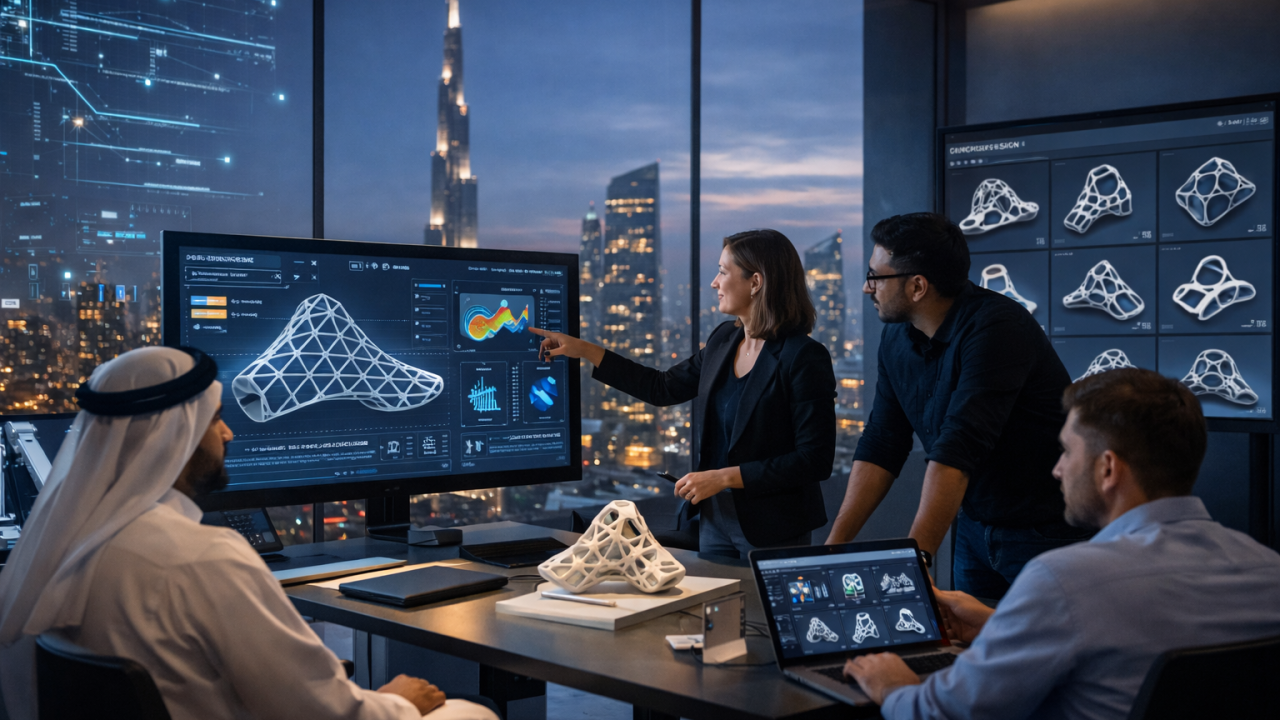
Throughout February, I spent time in the UAE. Conversations with designers, engineers, founders, and product leaders here have been a useful reminder that how technology is adopted often says more than the technology itself.
AI in product design is not new. What is interesting is how differently it is being approached. Less theatre. Less debate. More quiet integration.
These are three observations that have stood out to me.
1. AI is treated as infrastructure, not an experiment
In many regions, AI in product design still feels tentative. Pilot projects. Trials. Side tools. Something to “try” without committing too much of the organisation around it.
Here, the mindset feels different.
AI is assumed to be part of the system. It is embedded into workflows for concept generation, early feasibility, optimisation, and visualisation without much fanfare. Teams are not asking whether they should use AI. They are asking how their processes should change now that it exists.
That distinction matters. When AI is treated as infrastructure rather than an experiment, decisions move faster. Ambition increases. Teams design processes that assume intelligence and iteration will be cheap and plentiful, rather than scarce.
It feels less like adoption and more like acceptance.
2. Speed to visual clarity is shaping decisions early
Another pattern I’ve noticed is how heavily AI is being used to compress early-stage design time. Not to finalise products, but to reach clarity sooner.
AI-driven visualisation and concept exploration are allowing teams to put something tangible in front of stakeholders very early. That changes the nature of conversations. Decisions are no longer abstract or theoretical. They are grounded in form, direction, and intent.
What struck me is that this is not about producing polished designs. It is about alignment. AI is being used to get everyone looking at the same thing faster, before engineering complexity, budgets, or politics take over.
In practice, this reduces friction. Fewer meetings spent debating interpretations. More time spent making real choices.
AI here is accelerating understanding, not just output.
3. AI is enabling ambition rather than replacing people
Much of the global conversation around AI still centres on efficiency, cost reduction, or replacing human effort. That narrative feels far less dominant here.
What I’ve seen instead is AI being used to make bigger ideas feel achievable. Complex geometry. Challenging timelines. Uncertain feasibility. AI lowers the psychological barrier to exploration.
When iteration becomes cheap, people become bolder.
Designers are not being pushed aside. They are being freed up. Less time wrestling with repetitive modelling or early validation. More time thinking about the problem, the user, and the system as a whole.
There is a confidence that comes from knowing you can explore multiple directions without committing too early or burning time and budget. That confidence changes the kinds of questions teams are willing to ask.
What ties this together
Taken together, these observations point to something subtle but important.
In the UAE, AI in product design is not being framed as automation. It is being used to remove friction from thinking. To speed up understanding. To create confidence earlier in the process.
This feels particularly relevant in environments where ambition is high and timelines are tight. When the expectation is progress, not perfection, AI becomes a natural enabler rather than a disruptive force.
For me, it reinforces a broader lesson. The value of AI in product design is not just in what it produces, but in how it changes behaviour. Faster alignment. Earlier decisions. More confident exploration.
Those shifts matter long before a product ever reaches manufacturing.
If you are thinking about how AI fits into your own product development process, the question may not be which tools to adopt. It may be how your team’s mindset needs to change once rapid exploration and early clarity are no longer constraints.
If you’re exploring how AI-informed design and additive manufacturing can de-risk and accelerate your next product, ITERATE ® can help you navigate that journey with confidence. Speak with our team to explore what’s possible:

Gethin Roberts
ITERATE Business Development Executive
Stay in the Know
Do you want to stay updated on our latest projects, client insights, future tech trends, and social media highlights? Join ITERATE’s monthly mailing list!