For decades, the logic of product development has been broadly the same.
You identify a problem. You research the market. You design the product. You prototype it. You test it. You refine it. You invest in manufacture. Then you launch and hope the market responds.
It is a proven route, and in many cases it is still the right one. But it is also an expensive one. By the time a business reaches tooling, certification, manufacturing setup and launch, a significant amount of time and capital has already been committed. If the market response is weaker than expected, the cost of being wrong can be painful. As ITERATE’s own work highlights, one of the most common mistakes in innovation is committing to development and manufacturing before knowing whether a concept truly has market legs. (ITERATE)
That is why AI matters so much right now.
Not because it removes the need for engineering, prototyping or manufacture. It does not. But because it changes when and how businesses can validate demand.
Today, AI tools can help teams generate realistic concept visuals, sharpen positioning, test value propositions, explore routes to market and gather meaningful feedback before a product is fully developed. In other words, businesses can increasingly sell the promise before they build the product. ITERATE’s IDEA Engine is built around exactly this challenge – assessing technical feasibility, market potential and early-stage risk before expensive development begins. (ITERATE)
That is a major shift in the business model.
Traditionally, product businesses have invested upfront and recovered later. The risk sat at the beginning of the process. Now, AI is giving founders and innovation teams a way to move some of that risk forward into the validation phase. Instead of asking, “Can we afford to build this and then see if people want it?” the better question becomes, “Can we test desire, demand and commercial traction before we commit serious capital?”
Crowdfunding pointed in this direction years ago. It allowed businesses to build a prototype, tell a compelling story, gather pre-orders and prove there was appetite before moving into production. That model was powerful because it reduced uncertainty. But AI pushes the idea further. You no longer need to rely only on a finished prototype to start learning what the market thinks. You can test earlier, faster and at far lower cost through concept generation, market messaging, audience response and commercial exploration. ITERATE’s handbook makes a similar point in a pre-AI context: concepts allow earlier decisions, and real-world feedback helps refine products before bigger sums are spent.
This does not mean businesses should skip development discipline. That would be a mistake.
A compelling render is not a manufacturable product. A strong landing page is not proof of regulatory compliance. Early pre-orders do not remove the need for design for manufacture, engineering detail, certification or supply chain planning. ITERATE’s own capability pages make that balance clear. AI can accelerate feasibility and insight, but successful product development still requires structured execution, technical diligence and a clear path to manufacture. (ITERATE)
The real opportunity is not to replace the traditional process. It is to rearrange it.
The old model was often: design, develop, prototype, manufacture, launch.
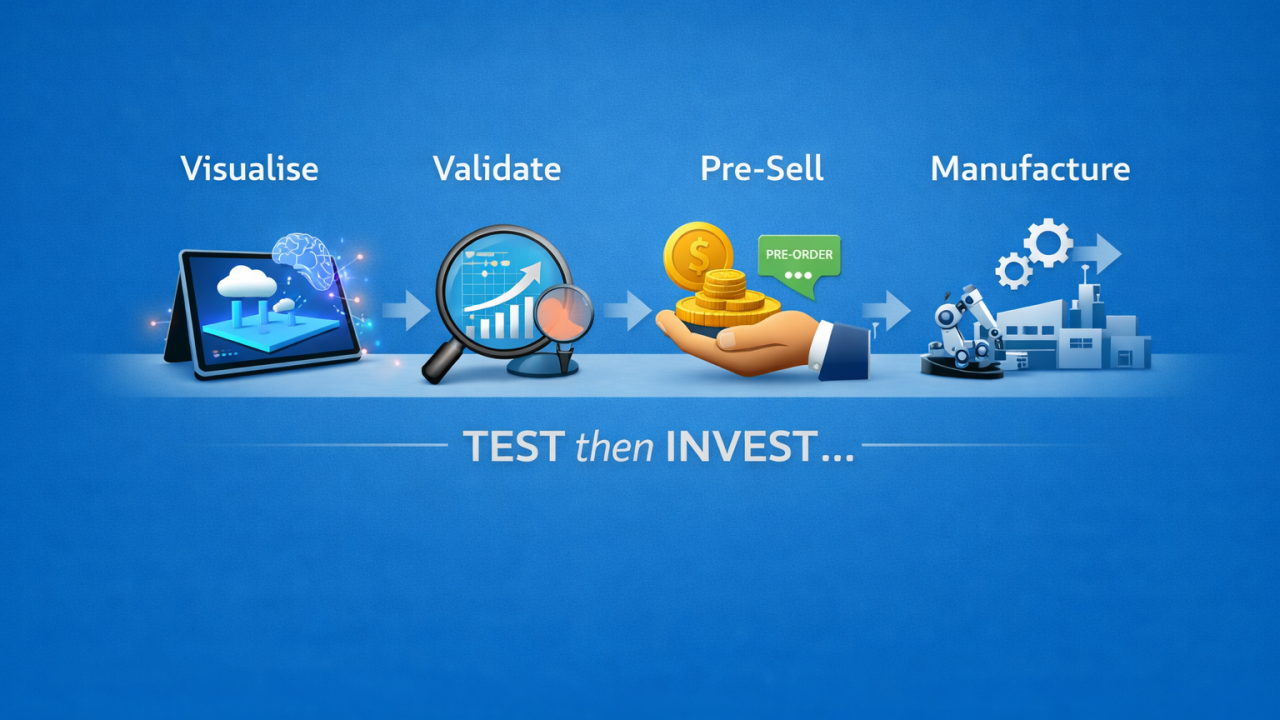
The emerging model is increasingly: visualise, validate, secure confidence, then invest in development and manufacture.
For startups, that can mean a lower-risk path to proving demand. For established businesses, it can mean stronger internal buy-in before committing budget. For investors, it can mean clearer evidence that a concept has commercial traction. And for product teams, it creates space to focus effort on ideas that have already shown signs of life in the market.
We can already see the value of this thinking in ITERATE’s broader approach. Whether it is AI-powered validation through IDEA Engine, feasibility-first thinking through PreFlight, or product work that connects early insight to practical delivery, the direction is the same: de-risk development by learning sooner. Even products like MOHONTO, the eco shower head, show how strong opportunities come from questioning assumptions early and shaping the offer around real user and market needs rather than blindly following convention. (ITERATE)
This is why the product business model is changing.
The winners will not just be the companies that can design and manufacture well. They will be the ones that can validate intelligently before they invest heavily. AI gives them a new way to do that. It helps turn guesswork into evidence, and evidence into action.
That does not eliminate risk. But it does make risk easier to see, shape and manage.
And in product innovation, that can make all the difference.
If you are exploring a new product and want to validate the opportunity before committing major development or manufacturing spend, speak with ITERATE about how to turn your concept into a clearer, smarter and more investment-ready proposition: (ITERATE)

Gethin Roberts
ITERATE Business Development Executive
Stay in the Know
Do you want to stay updated on our latest projects, client insights, future tech trends, and social media highlights? Join ITERATE’s monthly mailing list!